Many businesses measure performance, but far fewer have a KPI system that consistently helps them make better decisions and achieve their strategic goals.
Some organisations track too many indicators. Others focus on financial results without understanding what drives them. In many cases, KPIs are reported regularly but do not lead to clear actions or accountability.
An effective KPI system is more than a collection of numbers on a dashboard. It connects business objectives with measurable results, defines responsibilities, and helps managers and employees understand what needs to improve.
Building such a system does not require dozens of indicators or complex software. It requires a structured approach, relevant data, clear ownership, and consistent management routines.
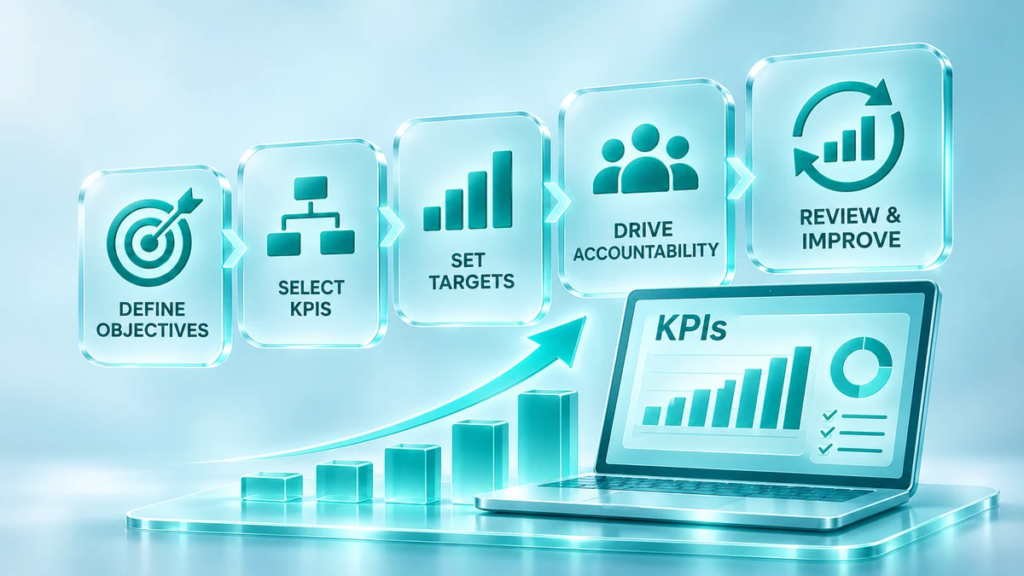
Here are eight practical steps to build an effective KPI system from scratch.
1. Start with Clear Business Objectives
Before selecting KPIs, define what the business wants to achieve.
KPIs should measure progress towards specific business objectives, not simply track everything that can be measured.
Typical business objectives include:
- Increasing revenue and profitability
- Improving operational efficiency
- Reducing production or service costs
- Improving customer satisfaction
- Increasing employee productivity
- Improving delivery performance
- Reducing errors, waste, and rework
For example, if the objective is to improve operational efficiency, relevant KPIs might include output per labour hour, operating cost per unit, process lead time, and error rate.
If the objective is to improve customer service, useful indicators could include customer satisfaction, complaint resolution time, and on-time delivery.
The key is to establish a clear connection between each KPI and a business objective.
Practical tip: Start with three to five strategic business objectives. Make sure each one is specific enough to guide the selection of meaningful performance indicators.
2. Select the Right KPIs
One of the most common mistakes when building a KPI system is selecting too many indicators.
Tracking dozens of metrics can make performance management complicated and reduce attention to the results that matter most.
A useful KPI should:
- Be directly linked to a business objective
- Measure something important to business performance
- Have a clear definition and calculation method
- Be based on reliable and accessible data
- Be understandable to the people responsible for it
- Support decisions and improvement actions
It is also important to distinguish between KPIs and supporting metrics.
A KPI measures progress towards a critical objective. Supporting metrics provide additional information that helps explain the result.
For example:
| Business Objective | Main KPI | Supporting Metrics |
| Improve productivity | Output per labour hour | Absence rate, downtime |
| Improve quality | Defect rate | Rework hours, error types |
| Improve delivery performance | On-time delivery (%) | Order processing time, transport delays |
| Reduce operating costs | Operating cost per unit | Labour cost, energy cost |
A business does not need to measure every supporting metric at the same management level.
Practical tip: Begin with a focused set of approximately 5–10 important KPIs for each relevant business function. The right number depends on the complexity of the operation and the level of responsibility.
3. Define Every KPI Clearly
A KPI system will not work if different departments or employees interpret the same indicator differently.
Every KPI should have a standard definition. Without one, reports may show inconsistent results, and management discussions can become focused on the numbers rather than the underlying performance.
For each KPI, document:
- KPI name: What is being measured?
- Purpose: Why is it important?
- Formula: How is it calculated?
- Unit: Percentage, hours, units, euros, or another measure
- Data source: Where does the information come from?
- Frequency: How often is it measured?
- Owner: Who is responsible for the result?
- Target: What level of performance is expected?
For example:
KPI: Labour Productivity
Formula: Total Output / Direct Labour Hours
Unit: Units per labour hour
Data source: Production or warehouse management system
Frequency: Daily monitoring, weekly review
Owner: Operations Manager
Target: Established using historical performance, capacity analysis, and improvement objectives.
Clear definitions make KPIs consistent, comparable, and easier to manage.
Practical tip: Create a KPI dictionary – a central document containing the definitions, formulas, owners, data sources, and targets for every KPI.
4. Set Realistic and Meaningful Targets
Measuring performance without a target makes it difficult to understand whether results are good or poor.
However, targets should not be selected arbitrarily. An unrealistic target can demotivate employees, encourage undesirable behaviour, or lead to manipulation of reported results.
Use several sources when setting targets:
- Historical performance
- Current operational capacity
- Customer requirements
- Available resources
- Industry benchmarks, where comparable
- Business strategy and improvement plans
For example, if a warehouse currently processes 100 order lines per labour hour, setting a target of 150 immediately may not be realistic.
A more effective approach could be to analyse the causes of current performance, identify improvement opportunities, and establish progressive targets.
It is also useful to distinguish between:
- Baseline: Current measured performance
- Target: Expected performance level
- Actual: Measured result
- Variance: Difference between actual and target
Practical tip: Review targets when business conditions, workload, technology, or processes change. A target should remain relevant, not simply stay unchanged because it was agreed last year.
5. Assign Clear Ownership and Accountability
A KPI without an owner is just a number in a report.
Every important KPI needs someone responsible for monitoring performance, understanding deviations, and coordinating improvement actions.
However, accountability should not mean blaming employees for results they cannot control.
Responsibilities should be assigned at the appropriate level:
- Business owners and senior management define strategic objectives.
- Department managers translate objectives into functional KPIs.
- Team leaders monitor operational performance.
- Employees understand how their work contributes to team and business results.
For example, an Operations Manager may own overall warehouse productivity, while team leaders are responsible for monitoring picking productivity and labour utilisation within their shifts.
The person responsible should have sufficient authority, information, and resources to influence the result.
Practical tip: For each KPI, define one accountable owner, the people who contribute to the result, and the actions expected when performance falls below target.
6. Establish a Regular Performance Review Routine
A KPI system only creates value when results are reviewed and translated into decisions.
Reporting performance once a month may be sufficient for some strategic indicators, but operational KPIs often require more frequent monitoring.
A practical performance management structure can include three levels:
| Review Level | Frequency | Main Focus |
| Operational | Daily or per shift | Current performance, deviations, immediate actions |
| Management | Weekly or monthly | Trends, root causes, corrective actions |
| Strategic | Monthly or quarterly | Business objectives, strategic progress, priorities |
A productive KPI review should answer five questions:
- What was the expected result?
- What actually happened?
- Where and why did performance differ?
- What action is required?
- Who is responsible, and when will it be completed?
Meetings should focus on understanding performance and solving problems rather than simply reading numbers from a dashboard.
Practical tip: Keep KPI reviews structured and action-oriented. Every important deviation should lead to a decision, an assigned owner, or a clear explanation.
7. Use Dashboards to Make Performance Visible
A well-designed KPI dashboard makes important information easier to understand and helps managers identify problems quickly.
However, a dashboard should support the management process, not replace it.
An effective dashboard should show:
- KPI name and definition
- Target and actual result
- Performance trend over time
- Variance against target
- Relevant breakdowns by department, process, or shift
- Status of improvement actions, where useful
For example, an operations dashboard might include productivity, labour utilisation, quality, delivery performance, and operating costs.
Tools such as Microsoft Power BI can combine data from different systems and provide a consistent view of business performance.
The most important principle is to show the information that supports decisions. A dashboard filled with unnecessary charts and indicators can make performance less clear rather than more transparent.
Practical tip: Design dashboards around the questions managers need to answer. Give different management levels access to the level of detail relevant to their responsibilities.
8. Connect KPIs with Continuous Improvement and Employee Motivation
The final step is to make the KPI system part of everyday management.
KPIs should not exist only for reporting purposes. They should help the organisation identify performance gaps, understand root causes, and improve processes.
When a KPI is below target, investigate the underlying reasons before deciding what action to take.
For example, lower productivity may be caused by:
- Equipment downtime
- Poor workforce planning
- Inefficient process design
- Inadequate training
- Material shortages
- Unbalanced workloads
Addressing the actual cause is more effective than simply demanding higher output.
KPIs can also support employee motivation when people understand how their contribution affects team and business results.
To achieve this:
- Communicate targets clearly
- Make performance information accessible
- Recognise improvements and good performance
- Involve employees in identifying solutions
- Ensure targets are fair and within reasonable influence
- Balance productivity with quality, safety, and customer service
Avoid rewarding one KPI in isolation. For example, rewarding picking speed without considering picking accuracy may increase errors and rework.
Practical tip: Treat KPI results as a starting point for improvement conversations, not as a tool for punishment. Encourage teams to take ownership of results and participate in solving problems.
Conclusion: Build a KPI System That Drives Results
An effective KPI system connects business strategy with everyday performance.
It helps organisations understand whether objectives are being achieved, identifies where improvements are needed, and makes responsibilities clear across the business.
To build a system that works:
- Start with clear business objectives
- Select a focused set of relevant KPIs
- Define indicators and calculation methods consistently
- Set realistic targets
- Assign clear ownership
- Establish regular performance reviews
- Make results visible through useful dashboards
- Connect performance measurement with continuous improvement
Remember that a KPI system is not a one-time project. It should evolve as the business grows, processes change, and strategic priorities develop.
TOP KPI helps businesses design practical KPI systems, improve performance management, and turn operational data into measurable business results.
Explore our AUDIT, DATA, ADVISORY, and POWER BI solutions to build a stronger, data-driven performance management system.