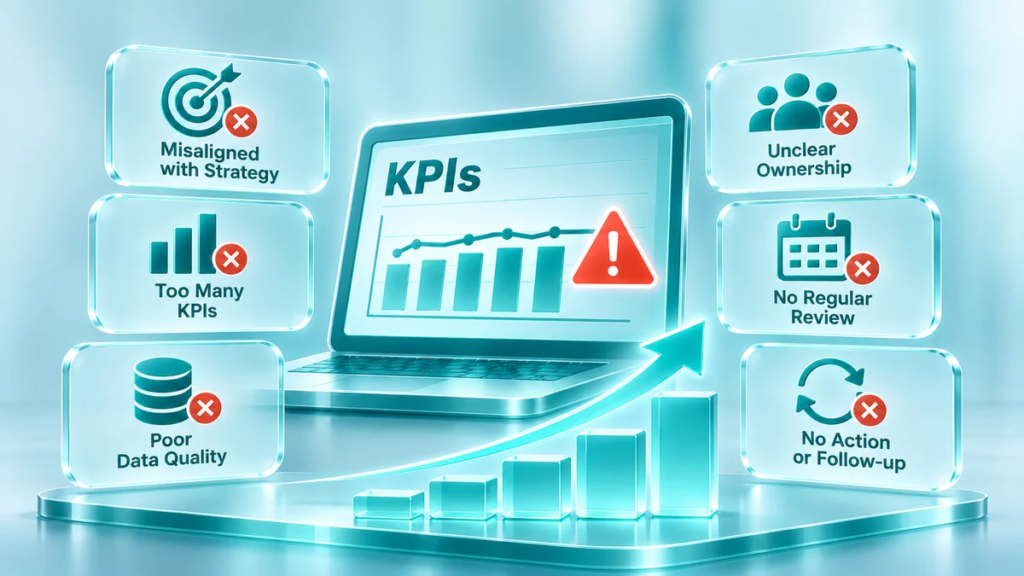
Many businesses invest time and resources in measuring performance. They create dashboards, define targets, prepare monthly reports, and track dozens of indicators across departments.
Yet business performance often remains unchanged.
Productivity does not improve. Operating costs continue to rise. Employees are unsure what they are responsible for, and management meetings focus more on explaining numbers than solving problems.
Why does this happen?
The problem is rarely the absence of KPIs. More often, it is the way the KPI system is designed, communicated, and used.
KPIs should help businesses understand performance, identify problems, make better decisions, and drive continuous improvement. When they become a reporting exercise rather than a management tool, their value is limited.
Here are eight common reasons why KPI systems fail to improve business performance – and what organisations can do differently.
1. Measuring Too Many KPIs
One of the most common mistakes is trying to measure everything.
Businesses often create extensive KPI lists covering every department, process, and activity. Although this may seem comprehensive, it can make performance management unnecessarily complicated.
When managers are presented with too many indicators, it becomes difficult to identify what really matters. Employees may also struggle to understand which results should receive their attention.
A KPI system should focus on the factors that have the greatest influence on business objectives.
For example, a warehouse might track dozens of operational metrics, but its key priorities could be:
- Picking productivity
- Picking accuracy
- Labour utilisation
- On-time dispatch
- Operating cost per order
Other metrics may still be useful for analysis, but they do not all need to be treated as key performance indicators.
How to improve it: Start with a limited number of strategically important KPIs. Select indicators that directly support business objectives and use supporting metrics only when they help explain performance.
2. KPIs Are Not Linked to Business Objectives
A KPI can be measured accurately and still be irrelevant.
This happens when organisations select indicators because data is available, because competitors use them, or simply because they have always been reported.
The result is a collection of numbers that does not clearly explain whether the business is moving towards its goals.
For example, a company may focus on increasing production volume. However, if customer demand is unchanged and inventory is already high, producing more may increase storage costs rather than improve business performance.
KPIs must reflect what the organisation is actually trying to achieve.
A useful way to connect strategy with measurement is:
Business Objective → Critical Success Factor → KPI → Target → Action
For example:
- Business objective: Improve profitability
- Critical success factor: Reduce production waste
- KPI: Material waste as a percentage of total material used
- Target: Reduce waste by an agreed amount
- Action: Analyse the main sources of waste and implement process improvements
How to improve it: Review every KPI and ask one question: If this indicator improves, will it contribute to an important business objective? If the answer is unclear, reconsider its role in the KPI system.
3. Targets Are Unrealistic or Poorly Defined
KPIs without targets provide limited direction. However, unrealistic or poorly defined targets can be equally damaging.
If targets are set without considering historical performance, operational capacity, available resources, or market conditions, employees may see them as arbitrary.
This can create frustration, reduce engagement, and encourage people to focus on achieving the number rather than improving the process.
Targets can also fail when the calculation method is unclear.
For example, two departments may report labour productivity differently. One may include indirect working hours, while the other excludes them. Their results cannot be compared reliably.
Every KPI needs a consistent definition and a target based on a clear rationale.
How to improve it:
- Establish a reliable performance baseline.
- Define the KPI formula and data source.
- Consider operational capacity and external conditions.
- Set realistic but challenging targets.
- Review targets when business circumstances change.
A good target should provide direction and encourage improvement without creating incentives for undesirable behaviour.
4. Nobody Takes Ownership of the Results
A KPI without clear ownership is unlikely to lead to meaningful improvement.
In some organisations, KPIs belong to the management team, the finance department, or the person preparing the report. However, the people responsible for the actual processes may not be involved in managing the results.
This creates a gap between measurement and action.
For example, if warehouse picking productivity is below target, who is responsible for investigating the cause? The warehouse manager? The shift supervisor? The process improvement team?
Without clear accountability, problems can remain unresolved or be passed between departments.
Accountability does not mean blaming individuals for every negative result. It means making responsibilities clear and ensuring that people have the authority and resources to influence performance.
How to improve it:
- Assign one accountable owner to each important KPI.
- Define who contributes to the result.
- Ensure owners understand the calculation and target.
- Give them access to relevant information.
- Agree on the actions expected when performance deviates.
People should be accountable for the areas they can reasonably influence.
5. KPI Meetings Focus on Reporting, Not Problem Solving
Many businesses hold regular performance meetings, but these meetings do not necessarily improve results.
Managers review dashboards, explain why targets were missed, and move on to the next indicator. The same problems appear in the following meeting, often with no clear progress.
A KPI review should lead to decisions and actions.
Instead of asking only why a number is below target, managers should investigate what caused the deviation and what can be done to prevent it from happening again.
A practical KPI review should answer five questions:
- What was the target?
- What was the actual result?
- What caused the difference?
- What action will address the cause?
- Who is responsible, and when will the action be completed?
For example, if picking productivity decreases, the team should investigate possible causes such as increased travel distances, replenishment delays, equipment availability, or changes in order complexity.
How to improve it: Introduce structured performance reviews. Record actions, owners, and deadlines, then check progress at the next meeting. Avoid allowing KPI meetings to become passive reporting sessions.
6. Employees Do Not Understand or Trust the KPI System
A KPI system cannot deliver its full value if employees see it as a control mechanism rather than a tool for improvement.
This often happens when targets are introduced without explanation, results are not communicated clearly, or employees have no opportunity to discuss the factors affecting their performance.
Another problem occurs when employees are evaluated using indicators they cannot influence.
For example, a warehouse picker may be measured on productivity, but frequent system interruptions or unavailable inventory can affect the result. Holding the employee solely responsible would be unfair and counterproductive.
A successful KPI system requires transparency, communication, and employee involvement.
Employees should understand:
- What is being measured
- Why the indicator matters
- How the result is calculated
- What is expected of them
- Which factors they can influence
- How performance information will be used
How to improve it: Explain the purpose of the KPI system, involve employees in identifying improvement opportunities, and recognise positive contributions. Use performance data to support constructive conversations rather than automatically assigning blame.
7. Data Is Inaccurate, Delayed, or Difficult to Access
Even a well-designed KPI system will produce poor decisions if the underlying data is unreliable.
Common data problems include:
- Different departments using different definitions
- Manual reporting errors
- Incomplete or missing information
- Delays between operational activity and reporting
- Data stored across disconnected systems
- Excessive manual spreadsheet work
For example, if production output is updated daily but labour hours are recorded only at the end of the month, managers may not have enough information to understand daily productivity changes.
Reliable KPI management requires consistent data definitions, clear ownership of data sources, and an appropriate reporting frequency.
Digital dashboards can help combine information from different systems and make performance easier to monitor.
Tools such as Microsoft Power BI can support this process by providing a consistent view of KPIs, trends, and performance deviations.
How to improve it: Start by checking the quality of the data behind your most important KPIs. Standardise definitions, automate repetitive reporting where practical, and make sure information is available at the frequency required for management decisions.
8. KPIs Are Not Connected to Continuous Improvement
Perhaps the biggest reason KPI systems fail is that organisations measure performance without systematically improving it.
A dashboard may show that productivity is below target, but unless someone investigates the causes and implements changes, the indicator is unlikely to improve.
KPIs should be part of a continuous improvement cycle:
- Measure: Understand current performance.
- Identify: Find gaps between actual results and targets.
- Analyse: Determine the root causes.
- Act: Implement corrective or improvement actions.
- Review: Check whether the actions produced the expected result.
- Standardise: Keep successful improvements in place.
For example, if order processing time is too high, the organisation should analyse the process, identify unnecessary steps or delays, test improvements, and measure the impact.
The KPI then becomes a way to verify whether the improvement has delivered results.
How to improve it: Connect every significant performance gap with an improvement action. Track not only KPI results, but also the progress and effectiveness of the actions intended to improve them.
A Practical Checklist: Is Your KPI System Working?
Use this checklist to evaluate whether your current KPI system supports real business improvement.
- Every KPI is linked to a clear business objective.
- The number of KPIs is manageable and focused.
- Each KPI has a standard definition and calculation method.
- Targets are realistic and based on reliable information.
- Every important KPI has a clearly assigned owner.
- Employees understand the indicators relevant to their work.
- Data is accurate, consistent, and available on time.
- Performance reviews result in documented actions.
- Improvement actions have owners and deadlines.
- The organisation checks whether actions actually improve results.
If several of these elements are missing, the issue may not be the KPIs themselves. It may be the management system surrounding them.
Conclusion: Turn KPI Reporting into Performance Improvement
KPIs do not improve business performance automatically.
They create value when they help people understand priorities, take responsibility, identify problems, and make better decisions.
The most common reasons KPI systems fail are too many indicators, weak links to business objectives, unrealistic targets, unclear accountability, ineffective meetings, poor communication, unreliable data, and a lack of continuous improvement.
The solution is not necessarily to introduce more KPIs or invest in more sophisticated dashboards. It is to build a practical system in which measurement leads to action.
TOP KPI helps businesses assess existing performance management systems, identify operational improvement opportunities, and build KPI frameworks that connect data, accountability, and measurable results.
Explore our AUDIT, DATA, ADVISORY, and POWER BI solutions to turn performance measurement into meaningful business improvement.