Many operational problems do not appear suddenly. They develop gradually throughout the day: orders fall behind schedule, productivity decreases, equipment becomes unavailable, quality issues increase, or workloads become unbalanced.
When these problems are identified too late, managers have fewer opportunities to correct them. What could have been a small operational adjustment may turn into missed deadlines, overtime, additional costs, or dissatisfied customers.
Daily performance meetings help organisations identify these issues early and take action before they affect overall results.
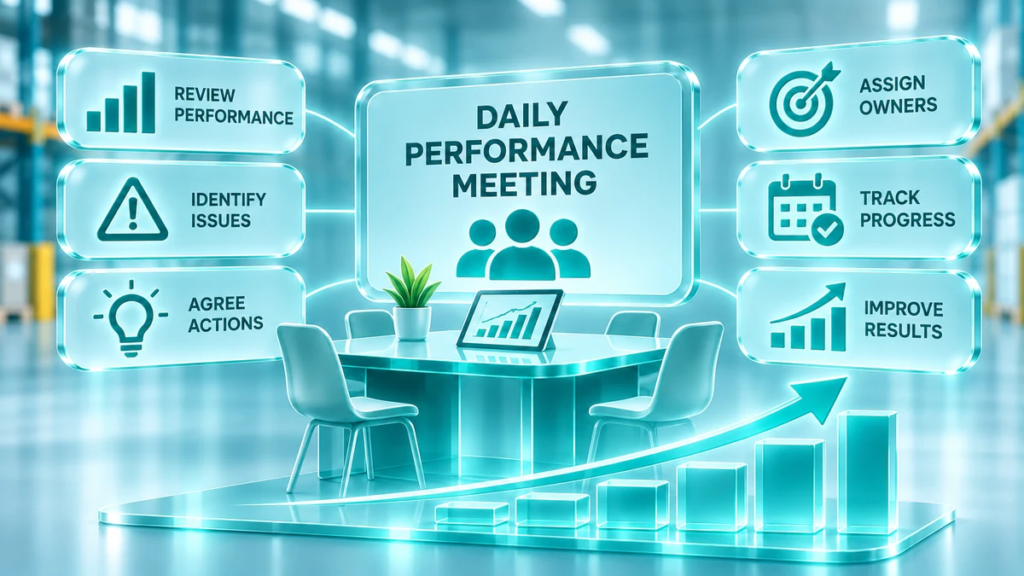
However, an effective daily meeting is not simply a review of yesterday’s numbers. It is a structured management routine that connects performance data with decisions, responsibilities, and follow-up actions.
Here are seven practical principles for using daily performance meetings to improve operational results.
1. Make Performance Visible Every Day
The first purpose of a daily performance meeting is to create a shared understanding of how the operation is performing.
Managers and team leaders should have access to a small set of relevant KPIs that show whether the operation is on track.
Depending on the business, these may include:
- Production output versus plan
- Orders processed or dispatched
- Productivity per labour hour
- Quality and error rates
- Equipment downtime
- Absence and staffing levels
- Customer service or delivery performance
The indicators should reflect the priorities of the specific operation. A manufacturing team, warehouse, and customer service department will not need exactly the same KPIs.
A simple visual performance board can display:
| KPI | Target | Actual | Status |
|---|---|---|---|
| Daily output | 1,000 units | 940 units | Below target |
| Labour productivity | 25 units/hour | 23.5 units/hour | Below target |
| Quality rate | 98% | 98.5% | On target |
| On-time completion | 95% | 92% | Below target |
Illustrative figures only.
This makes performance gaps visible and helps the team focus on the most important issues.
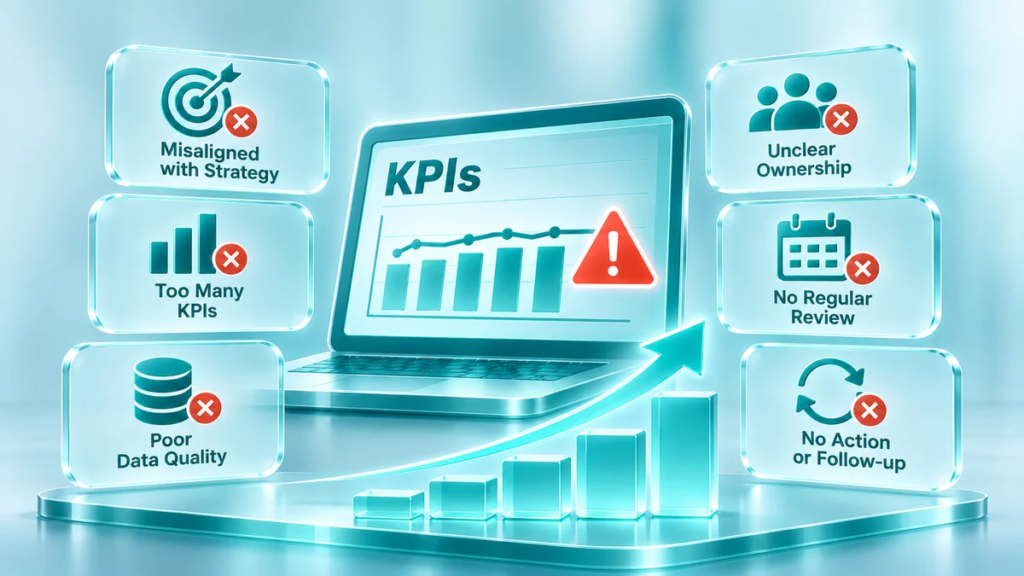
Practical tip: Display only the KPIs that help the team understand and manage its daily performance. Too many indicators make the meeting harder to follow.
2. Establish a Consistent Meeting Structure
Daily performance meetings should be short, predictable, and focused.
If every meeting follows a different structure, important topics may be missed and discussions can easily lose direction.
A practical meeting structure could include:
- Previous shift or day: What were the results?
- Current performance: Are we on track against today’s plan?
- Problems and deviations: What is preventing us from achieving the expected result?
- Actions: What needs to be done, by whom, and by when?
- Follow-up: Were the previous actions completed, and did they work?
For most operational teams, a meeting of approximately 10–15 minutes is a useful starting point. The appropriate duration depends on the size and complexity of the operation.
The meeting should take place at a consistent time, ideally before or at the beginning of the operational shift, when there is still time to influence the day’s results.
Practical tip: Use the same agenda every day. Consistency helps participants prepare and makes the meeting easier to manage.
3. Focus on Deviations, Not Just Numbers
Reporting KPI results is only the beginning. The real value comes from understanding why performance differs from the plan.
If a productivity target is missed, simply stating that the result was below target does not solve the problem.
The team needs to identify the reasons behind the deviation.
For example, lower warehouse picking productivity could be caused by:
- Increased travel distances
- Delayed replenishment
- Unavailable equipment
- Changes in order complexity
- Insufficient staffing
- System interruptions
Similarly, lower production output could result from equipment downtime, material shortages, quality problems, or unbalanced workloads.
A useful approach is to ask:
- What happened?
- Where did it happen?
- When did it start?
- What was the impact?
- What is the most likely cause?
- What can we do now?
Not every problem requires a lengthy root cause analysis during the daily meeting. More complex issues can be assigned for further investigation.
Practical tip: Discuss significant deviations and recurring problems first. Avoid spending valuable meeting time explaining indicators that are already performing as expected.
4. Turn Problems into Clear Actions
A performance meeting has little value if identified problems do not result in action.
Every important issue should lead to a clear next step.
An effective action should specify:
- Problem: What needs to be corrected?
- Action: What will be done?
- Owner: Who is responsible?
- Deadline: When should it be completed?
- Expected result: What improvement should it deliver?
For example:
| Problem | Action | Owner | Deadline |
|---|---|---|---|
| Picking delays in Zone A | Review replenishment schedule | Warehouse Supervisor | Today, 12:00 |
| High equipment downtime | Check recurring technical faults | Maintenance Team Leader | Today, 15:00 |
| Uneven workload | Reallocate two employees during peak hours | Shift Manager | Next shift |
Illustrative examples.
Actions should be specific enough to verify. “Improve productivity” is not an action. “Review picking routes in Zone A and propose a revised layout” is much clearer.
Practical tip: Keep an action log visible to the team. If an action has no owner or deadline, it is unlikely to receive consistent attention.
5. Follow Up on Previous Actions
One of the most common weaknesses in performance management is the lack of follow-up.
Teams identify problems, agree on actions, and move on. A few days later, the same issues appear again because nobody checked whether the agreed actions were completed or effective.
Daily meetings create a natural follow-up routine.
At the beginning of each meeting, review outstanding actions:
- Was the action completed?
- Was it completed on time?
- Did it solve the problem?
- Is further work required?
- Should the improvement become a standard process?
It is important to distinguish between completing an action and achieving the intended result.
For example, a supervisor may complete a review of warehouse picking routes. However, the review itself does not prove that productivity has improved. The result must be measured after implementation.
Practical tip: Track both action completion and the impact on performance. This prevents teams from confusing activity with actual improvement.
6. Involve Employees in Problem Solving
Daily performance meetings should not be one-way communication from managers to employees.
People working directly in operational processes often have the best understanding of practical problems. They know where delays occur, which tasks create unnecessary work, and what prevents them from achieving expected results.
Involving employees helps managers identify issues that may not be visible in reports.
Encourage team members to:
- Highlight operational problems
- Explain obstacles affecting performance
- Suggest practical improvements
- Share successful ways of working
- Raise safety and quality concerns
- Take responsibility for agreed actions within their roles
The meeting should create an environment where problems can be reported openly without automatically blaming individuals.
If employees are afraid to report issues, management may see an incomplete picture of operational performance.
Practical tip: Ask the team one focused question during the meeting: “What is the biggest obstacle preventing us from achieving today’s plan?” This encourages practical discussion without extending the meeting unnecessarily.
7. Connect Daily Meetings with Weekly and Monthly Management Reviews
Daily meetings are effective for managing immediate operational performance, but they cannot replace broader management reviews.
Different types of performance discussions serve different purposes.
| Review Level | Frequency | Main Purpose |
|---|---|---|
| Daily team meeting | Daily or per shift | Manage current performance and immediate problems |
| Department review | Weekly | Analyse recurring issues, trends, and improvement actions |
| Management review | Monthly | Review business KPIs, objectives, and resource priorities |
For example, a daily meeting may identify that picking productivity has decreased because of frequent replenishment delays.
The weekly review can analyse whether this is a recurring problem and identify the underlying process causes.
The monthly management review can assess the impact on labour costs, service levels, and overall warehouse performance.
This creates a connection between everyday operational decisions and broader business objectives.
Practical tip: Use daily meetings to manage today’s operation, weekly reviews to solve recurring problems, and monthly reviews to evaluate overall performance and priorities.
How to Measure the Effectiveness of Daily Performance Meetings
Introducing daily meetings does not automatically guarantee better results. Their effectiveness should also be measured.
Useful indicators may include:
- Percentage of agreed actions completed on time
- Number of recurring operational problems
- Time taken to resolve identified issues
- KPI deviations identified and addressed during the shift
- Improvement in productivity, quality, or delivery performance
- Meeting duration and attendance consistency
These indicators help management understand whether meetings are creating value or simply adding another administrative task.
The most important measure is not how many meetings take place, but whether the meetings lead to faster problem resolution and better operational results.
Conclusion: Make Daily Performance Management Part of the Operating Routine
Daily performance meetings help businesses move from reactive management towards proactive operational control.
They create a regular opportunity to review results, identify problems, agree on actions, and check whether improvements are working.
To make them effective:
- Use a small number of relevant KPIs.
- Follow a consistent meeting structure.
- Focus on deviations and their causes.
- Assign clear actions, owners, and deadlines.
- Follow up on previous commitments.
- Involve employees in problem solving.
- Connect daily discussions with wider management reviews.
When implemented consistently, daily performance meetings can improve communication, strengthen accountability, reduce delays, and help teams achieve operational targets.
TOP KPI helps organisations build practical performance management routines, establish effective KPI systems, and improve operational results through structured management and continuous improvement.
Explore our AUDIT, DATA, IMPLEMENTATION, and POWER BI solutions to turn daily performance information into measurable business improvements.